Published on 23 October 2026
How to choose a property developer in Kinshasa
How to choose a property developer in Kinshasa
Choosing a property developer in Kinshasa means choosing who will hold your money for months, sometimes years, before handing you the keys. A beautiful off plan apartment is worth nothing if the developer does not deliver, delivers late or cannot transfer a clean title. Here is a simple, honest method to compare developers, with 10 checks, the warning signs to know and a checklist you can print.
Safricode is a developer. So we have an obvious interest in this subject. That is why this method ranks no one: it gives you the questions to ask every developer, including us.
Why the developer matters more than the apartment
When you buy a finished apartment, you see what you are buying. When you buy off plan or during construction, you are buying a promise. The quality of that promise depends mainly on who makes it.
The developer is responsible for the land, the approvals, the funding of the build, the choice of contractors, sticking to the plans and the handover. After the keys are handed over, it also manages part of the building's life: snag lists, repairs and sometimes the management of shared areas.
An average apartment delivered on time by a serious developer is often a better buy than a superb apartment on paper backed by a fragile company. If you plan to buy before construction is finished, also read our guide to buying off plan in Kinshasa.
10 checks to choose a property developer in Kinshasa
1. Projects already delivered
This is the first check, and the easiest to verify. How many buildings has the developer already handed over to their owners? Where are these buildings? Can you see them with your own eyes?
For Safricode, the About page states 130 projects built and delivered and 30 projects under construction. Do not take our word for it: ask to visit, as you would with any developer.
2. The land title
The land must belong to the developer, or be covered by a clear written agreement with the owner. In the DRC, the only legal title recognised is the registration certificate (certificat d'enregistrement), issued by the Registrar of Land Titles (Conservateur des titres immobiliers). A livret de logeur, a fiche parcellaire or a simple private sale agreement is not a title. Ask for a copy of the land's registration certificate, then have a notary check at the Land Registry the name of the holder and that there is no mortgage or dispute.
3. Building approvals
A serious project has the required approvals before works start. The document to ask for is the building permit (permis de construire). Since 2022, it has been issued only by the one stop office for building permits (Guichet unique de délivrance du permis de construire, GUPEC), set up by decree n° 22/21 of 24 May 2022. Ask for the permit reference and its date: a permit is valid for 3 years, renewable once.
4. A clear written contract
The reservation or sale contract must state the exact unit, the area, the price, the payment schedule, the planned delivery date, the penalties for delay and the cancellation terms. A vague or purely verbal contract is a risk. The DRC has no dedicated off plan sales law, like the VEFA in France, so the contract is your main protection. For the sale to be registered in your name, the deed of sale must also be signed before a notary. Have the contract reviewed by a lawyer or notary before you sign.
5. Financial strength
A build that stops for lack of money is the worst situation for a buyer. Ask the question openly: does the site depend only on buyers' payments, or does the developer also have its own funds and partners? A developer who is comfortable with the subject will answer you directly.
6. A visible site that is moving forward
If the building is under construction, go there. Check whether the site is active, whether the teams are working, and whether progress matches what you were told. Go back a second time a few weeks later.
7. Payments linked to progress
A reasonable payment schedule follows the stages of the build: foundations, structure, roof, finishes. Be careful with a request for full payment very early, with no link to progress. Note, however, that according to Mbote (January 2026), many foreign buyers pay 70% to 100% of the price upfront, because mortgages remain very limited. If you pay a lot early, your other checks must be even stronger.
8. Written specifications
Which materials, which finishes, which equipment? A written technical specification, attached to the contract, protects you. For example, for Zarina Résidence in la Gombe, Safricode publishes the list of planned facilities: pools, gym, sauna, crèche, 24/7 backup power and a water reserve. This kind of detail must appear in black and white in your documents.
9. After sales service
What if a leak appears three months after the handover? Who manages the shared areas, the generator, the security? Ask how snags at handover are dealt with, which warranty the developer commits to for defects, and for how long. Have that warranty written into the contract: a verbal promise does not protect you.
10. A team you can reach and identify
A physical office, landline numbers, the names of managers: these are simple but important signs. A developer you can only reach through a messaging app, with no address, calls for more caution. Safricode's offices, for example, are in Immeuble Le Prestige, avenue Tabu Ley Rochereau, in la Gombe.
Warning signs
Some signs should make you slow down, even if you really like the project.
- Pressure to sign fast: "There is only one apartment left, you must pay today." A real opportunity can wait a few days while you think.
- Documents refused or always "in progress": Land title, permit, standard contract: if they refuse to show them to you, that is a problem.
- A price far below the market: According to Mbote (January 2026), new builds usually sell for 15% to 30% more than resale homes in the same areas. A much lower price should make you ask why.
- No delivered building to visit: Computer generated images do not replace a lived in building.
- Cash payment without a receipt: Every payment must come with a receipt and go through a bank account in the company's name. The 2025 land reform also provides that property transactions go through banks, and the Central Bank's rules ban cash payments of 10,000 $ or more.
- A site that has been stopped for a long time: Ask for the reason and the planned restart date, in writing.
- A "guaranteed" return: No one can guarantee price growth or future rent. If you are promised a fixed return, ask who guarantees it, on what basis, and ask for it to be written into the contract.
- A contact person who keeps changing: If every meeting is with a different person who does not know your file, follow up after the sale may be difficult.
Questions for a first meeting
Take this list with you when you meet the developer. Write down the answers, then compare developers with each other.
- Which buildings have you already delivered, and can I visit one?
- Who owns the land, and can I see the land document?
- What is the building permit reference?
- What is the planned delivery date, and what does the contract say if it is late?
- How is the build funded?
- What is the payment schedule, and which stages of the build does it match?
- Which finishes and equipment are included, in writing?
- Who manages the building after delivery, and at what cost?
- Which warranty covers defects after the handover?
- Can my lawyer review the contract before I sign?
A good developer answers all these questions calmly. If they dodge questions 2, 3 or 10, take time to think.
Printable checklist
Tick each line for each developer you compare.
| Check | Developer A | Developer B | Developer C |
|---|---|---|---|
| 1. Delivered projects, visited on site | [ ] | [ ] | [ ] |
| 2. Land document seen and checked by a notary | [ ] | [ ] | [ ] |
| 3. Building permit checked | [ ] | [ ] | [ ] |
| 4. Written contract reviewed by a lawyer | [ ] | [ ] | [ ] |
| 5. Funding of the build explained | [ ] | [ ] | [ ] |
| 6. Site visited twice | [ ] | [ ] | [ ] |
| 7. Payments linked to progress | [ ] | [ ] | [ ] |
| 8. Technical specification attached to the contract | [ ] | [ ] | [ ] |
| 9. Clear after sales service and warranty | [ ] | [ ] | [ ] |
| 10. Office, address and managers identified | [ ] | [ ] | [ ] |
If a developer ticks fewer than seven boxes, it is better to keep checking before you pay a deposit.
Frequently asked questions
How do I know a developer is reliable?
First look at what they have already delivered, and go and see it. Then check the land and permit documents with the help of a notary. Finally, talk to owners who live in their buildings: their experience is worth more than any brochure.
What documents should I ask for?
At a minimum: the land document, the building permit reference, the reservation or sale contract, the technical specification and the payment schedule. For the company, ask for its articles of association, its entry in the trade register (RCCM), its national identification number and its tax number, obtained through the one stop office for business creation (Guichet unique de création d'entreprise, GUCE). Have everything checked by a notary or lawyer before you pay.
Should I go through an agency or the developer?
Both are possible. Going directly to the developer gives you direct access to the project team and the documents. An agency can help you compare several projects and several neighbourhoods. Our guide on how to buy an apartment in Kinshasa walks you through the whole process, step by step.
Come and see what we deliver
The best way to judge a developer is still to visit a building they have already delivered, talk to the residents and look closely at the finishes. We invite you to do this with us, then with the other developers you are considering. You can browse our projects to prepare your visit.
Visit a building Safricode delivered:
Phone / WhatsApp: +243 991 977 779 | Email: info@safricode.com
Office: Immeuble Le Prestige, avenue Tabu Ley Rochereau, la Gombe, Kinshasa. You can also get in touch through our contact page.
Sources
- Mbote, « Combien coûte un appartement à Kinshasa en 2026 » (January 2026): Link
- Safricode, About page: Link
- Safricode, Our Projects: Link
- Safricode, Zarina Résidence: Link
- ACP, "Cadastre foncier : le certificat d'enregistrement, seul document ayant cours légal en RDC": Link
- US Department of State, 2023 Investment Climate Statement, DRC (land title): Link
- Ministerial order nº 058 of 13 June 2022 on building permits (GUPEC): Link
- Land law of 20 July 1973, article 231 (authentic deed): Link
- ACP, main points of the land reform (May 2026): Link
- Central Bank of Congo, exchange regulation of 25 March 2014 (article 7): Link
- Cliffe Dekker Hofmeyr, post incorporation requirements in the DRC (GUCE): Link
Real Estate Investment
Building charges and management in Kinshasa: who pays for what
Backup power, water, security, upkeep: how building service charges and the syndic work in a new apartment building in Kinshasa, and what to ask.
Real Estate Investment
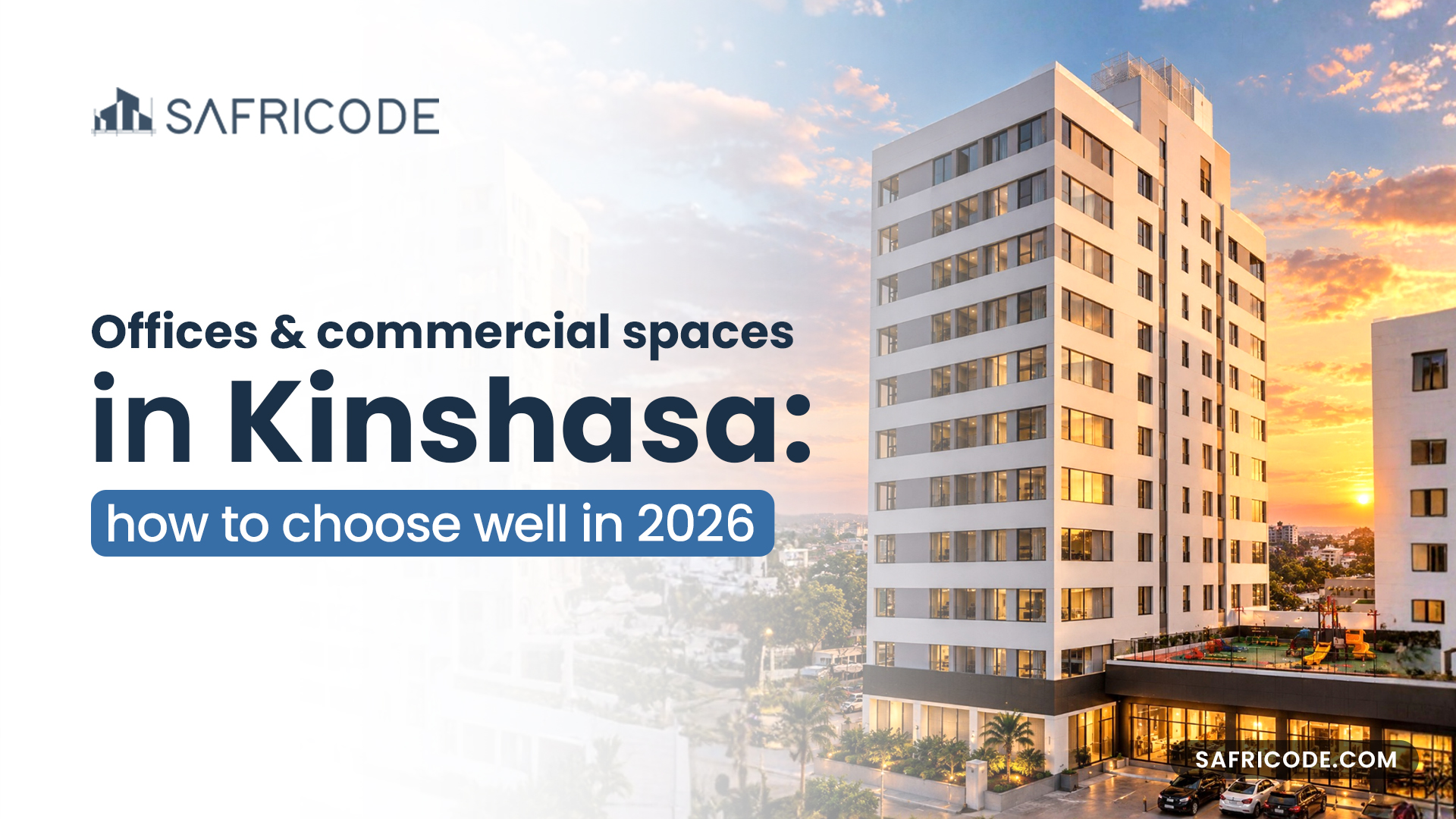
Offices and commercial spaces in Kinshasa: how to choose well in 2026
Area, building services, power, parking, renting or buying: how to choose an office or a shop in Kinshasa in 2026, and what to check in a lease.
Real Estate Investment
Renting out your apartment in Kinshasa: the landlord's guide
Setting the rent, choosing a tenant, writing the lease, handling maintenance: the steps to rent out your apartment in Kinshasa without bad surprises.
Real Estate Investment
Buy to let in Kinshasa: the numbers to run before you invest
Rent, charges, vacancy, upkeep, net yield: how to tell if an apartment you rent out in Kinshasa will really pay off.
Real Estate Investment
Lubumbashi real estate in 2026: the market and what you need to know
Lubumbashi, a key DRC market: demand, buyer profiles, how to check a project from afar and tips to buy or invest in 2026.
Real Estate Investment
New or older apartment in Kinshasa: which to choose in 2026
Price, service charges, power, water, guarantees, resale: a clear comparison of new build and older apartments in Kinshasa in 2026.
Real Estate Investment
La Gombe real estate: the complete neighbourhood guide
Prices, sectors, new residences and buying tips: what to know before you buy an apartment in la Gombe, Kinshasa, in 2026.
Real Estate Investment
Living in Kinshasa as an expat: housing, areas and costs
Where expats live in Kinshasa, what rent and services cost, and what to look for in a building: a practical housing guide for 2026.
Real Estate Investment
Mortgages in the DRC in 2026: how to finance an apartment
Rates, deposit, banks, payment plans: the real options to finance an apartment in Kinshasa in 2026, and how to compare them.
Real Estate Investment
Kinshasa ring roads and city extension: which areas could gain value
South east and south west ring roads, the Maluku extension, a financial centre: what Kinshasa's major projects mean for property prices.
Real Estate Investment
Construction cost per square metre in Kinshasa in 2026: a developer's figures
Structural work, finishes, materials, labour: the real construction cost per square metre in Kinshasa in 2026, item by item, with examples.

Real Estate Investment
Buying property in Congo from abroad: a diaspora guide
Video visits, remote payments, power of attorney and title checks: how to buy an apartment in Kinshasa while living in Europe or North America.
Real Estate Investment
Best areas to buy property in Kinshasa in 2026
La Gombe, Ngaliema, Limete, Kintambo: prices, rents, yields and risks by area, to help you choose where to buy in Kinshasa in 2026.
Real Estate Investment
Ngaliema property guide: from Binza to GB
Binza, GB, Ma Campagne, Mont Fleury: prices, lifestyle and new residences in Ngaliema. The area guide to buying or investing in Kinshasa in 2026.
Real Estate Investment
Residential towers in Kinshasa: why the city is building upwards
Scarce land, security, river views: why residential towers are rising in Kinshasa, and what to check before you buy an apartment in one.
Real Estate Investment
Luxury apartments in Kinshasa: what high end really means
Views, finishes, backup power, security and services: how to tell a true luxury apartment in Kinshasa from a marketing label.
Real Estate Investment
Buying off plan in Kinshasa: how it works and what to check
Buying an apartment off plan in Kinshasa: benefits, risks, documents, contract terms and how to follow construction, explained by a developer.
Real Estate Investment
Apartment payment plans in Kinshasa explained
What does an apartment in Kinshasa cost in 2026? Prices per m² by area, what new builds include, and buying costs, from a developer that builds them.
Real Estate Investment
Apartments for sale in Kinshasa: 2026 price guide
What does an apartment in Kinshasa cost in 2026? Prices per m² by area, what new builds include, and buying costs, from a developer that builds them.
Real Estate Investment
Real Estate Investment Guide: Start Smart in 2026
Buying property can feel like a big leap, especially when you are spending savings you worked hard to build.
Real Estate Investment
How to Buy Apartment in Kinshasa Without Costly Surprises
If you are researching how to buy apartment property in Kinshasa, it is essential to start with verified facts rather than relying solely on polished listing photos.
Real Estate Investment
Safricode Kinshasa and Long-Term Property Value
Explore the benefits of investing in Safricode projects in Kinshasa and discover why Congo's growing real estate market attracts investors.
Real Estate Development
Why Safricode Leads as a Real Estate Developer in Kinshasa
Discover why SAFRICODE is a leading real estate developer in Kinshasa, with trusted residential and commercial projects built for long-term value.
Trends
Current Construction Trends in Kinshasa
Kinshasa is emerging as a major hub of modern architecture in Africa. The latest trends in construction reflect a fusion of local culture with contemporary influences
Guide
Guide To Maintaining Your Apartment In Kinshasa: Tips And Best Practices
Taking care of your apartment in Kinshasa is essential to ensure its good condition, safety, and preservation of its value. In this article, we

Guide
TIPS FOR A SUCCESSFUL MOVE TO KINSHASA
Moving to the bustling city of Kinshasa can be an exciting yet demanding experience. To help you plan and execute a smooth move, here are some

Investment
Investing in Real Estate in Kinshasa: Essential Tips for Success
Kinshasa, the dynamic capital of the Democratic Republic of Congo, offers a rapidly expanding real estate market, rich in investment opportunities.